%20scale(0.100000,-0.100000)'%20fill='%23000000'%20stroke='none'%3e%3cpath%20d='M1100%2012055%20l0%20-2695%202310%200%202310%200%200%20385%200%20385%20-1925%200%20-1925%200%200%20770%200%20770%201925%200%201925%200%200%20385%200%20385%20-1925%200%20-1925%200%200%20770%200%20770%201925%200%201925%200%200%20385%200%20385%20-2310%200%20-2310%200%200%20-2695z%20M6550%2012060%20l0%20-2690%202690%200%202690%200%200%201535%200%201535%20-1535%200%20-1535%200%200%20-385%200%20-385%201150%200%201150%200%200%20-770%200%20-770%20-1920%200%20-1920%200%200%201925%200%201925%202305%200%202305%200%200%20385%200%20385%20-2690%200%20-2690%200%200%20-2690z%20M1100%205805%20l0%20-2695%20385%200%20385%200%200%20770%200%20770%201073%200%201072%20-1%2075%20-82%20c41%20-45%20360%20-392%20708%20-770%20l633%20-687%20524%200%20c289%200%20525%202%20525%205%200%203%20-109%20124%20-242%20268%20-608%20657%20-1153%201251%20-1156%201258%20-2%205%20314%209%20702%209%20l706%200%200%201925%200%201925%20-2695%200%20-2695%200%200%20-2695z%20m4620%20770%20l0%20-1155%20-1925%200%20-1925%200%200%201155%200%201155%201925%200%201925%200%200%20-1155z%20M7320%205795%20l0%20-2695%202305%200%202305%200%200%20385%200%20385%20-1920%200%20-1920%200%200%20770%200%20770%201920%200%201920%200%200%20385%200%20385%20-1920%200%20-1920%200%200%20770%200%20770%201920%200%201920%200%200%20385%200%20385%20-2305%200%20-2305%200%200%20-2695z'/%3e%3c/g%3e%3c/svg%3e)
Dubai Market · 9 min read
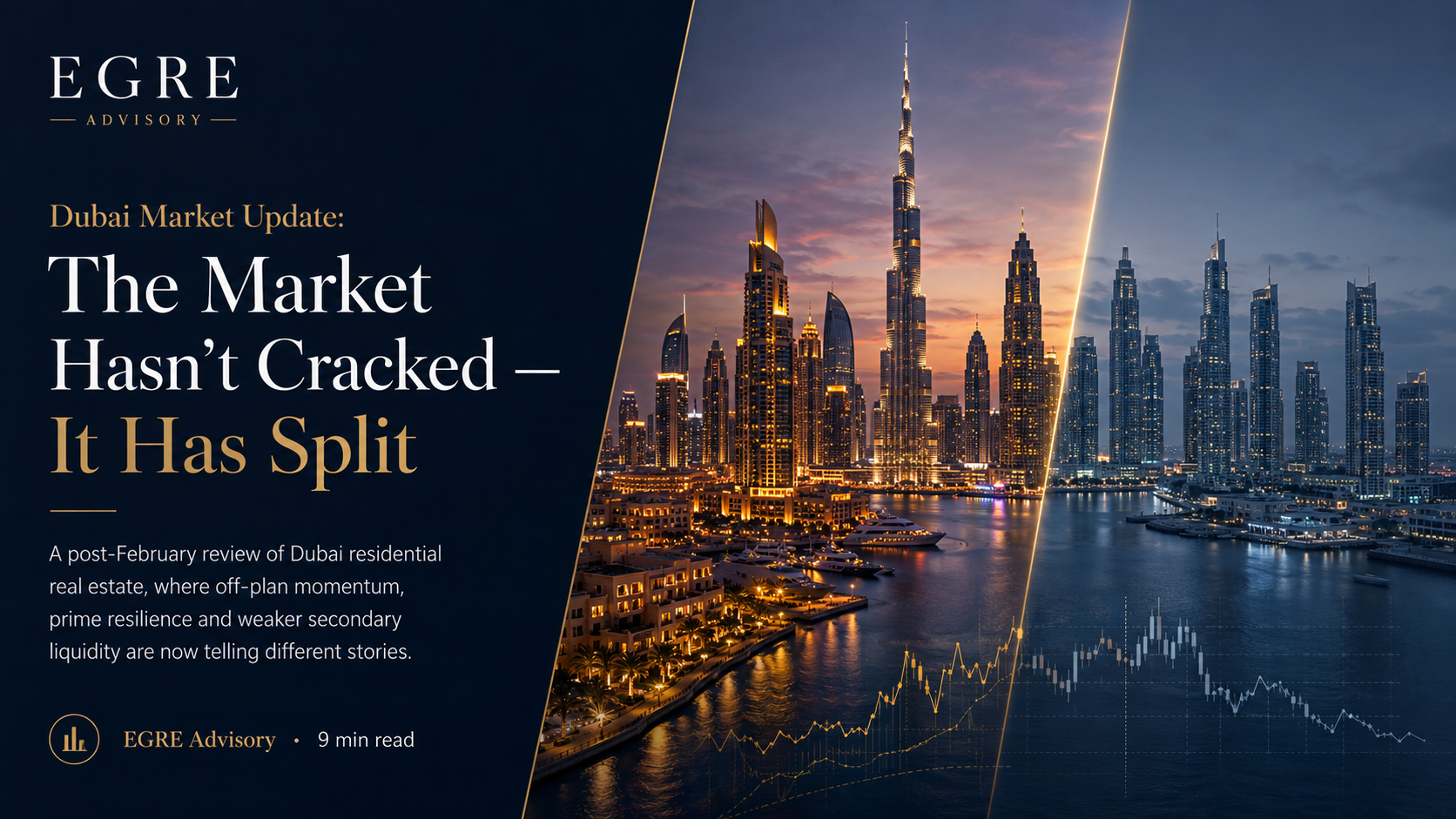
Dubai Market Update: The Market Hasn't Cracked — It Has Split
A post-February review of Dubai residential real estate, where off-plan momentum, prime resilience and weaker secondary liquidity are now telling different stories.
For most of the last cycle, Dubai residential real estate has been discussed as one broad market.
Prices were rising.
Transaction volumes were strong.
International buyers were active.
Developers were launching aggressively.
And confidence, at least on the surface, remained high.
But after February, the market has become harder to describe in one sentence.
The more accurate view is this:
Dubai has not cracked. It has split.
Off-plan continues to dominate transaction activity. Prime assets remain supported by wealth migration, lifestyle demand and scarcity. But parts of the secondary market are beginning to behave differently. Liquidity is becoming more selective, buyers are more disciplined, and some sellers are starting to meet the market rather than price ahead of it.
That is not necessarily a crisis. It is a cycle becoming more mature.
At EGRE, we believe the next phase of the Dubai market will be less about broad exposure and more about asset selection, liquidity, pricing evidence and exit discipline.
1. The headline numbers still look strong
On the surface, Dubai's residential market remains active.
Knight Frank reported 45,158 residential transactions in Q1 2026, with total sales value of AED 137.3 billion. Off-plan remained the dominant segment, accounting for 72% of all transactions, with 32,607 off-plan sales compared with 12,551 ready transactions. Citywide residential prices were reported at AED 1,933 per sq ft, up 10.5% year-on-year and 1.8% quarter-on-quarter.
CBRE's Q1 2026 review also described a strong start to the year, with over 45,000 residential transactions worth AED 137 billion, heavily driven by off-plan sales. However, CBRE also noted a notable slowdown in March, moderating price and rental growth, and a more cautious tone among some investors as new supply enters the market.
Savills reported a similar pattern: Q1 transaction activity remained substantial, off-plan accounted for 72% of transactions, but secondary market volumes declined by approximately 40% month-on-month in March.
So the market is not inactive.
But the question is no longer simply:
"Are people still buying?"
The better question is:
"Where is liquidity still deep, and where is it beginning to thin?"
2. Off-plan is still carrying the market
The most important structural feature of Dubai's residential market today is the dominance of off-plan.
This is not accidental.
Developers have several advantages over private sellers. They can control pricing, adjust payment plans, create urgency through launch strategy, offer incentives, and distribute product globally through large broker networks.
A private seller in the secondary market cannot do that.
If demand softens, a private seller has two choices: reduce the price or wait. A developer has more tools. They can stretch payment terms, offer post-handover plans, absorb some fees, adjust commission structures, increase broker incentives or reposition the launch.
This is why off-plan can continue to show strong transaction activity even when secondary liquidity becomes more selective.
It does not mean off-plan is automatically safer. It means the pricing mechanism is different.
Off-plan is often driven by narrative, payment structure and future expectation.
Secondary is driven more directly by clearing prices, comparable evidence and current buyer appetite.
That difference matters.
3. Secondary is where liquidity shows first
In every property cycle, liquidity usually moves before headline prices.
Sellers may hold asking prices for months. Brokers may continue quoting last quarter's comparables. Developers may continue launching. But underneath the headline data, buyer behaviour can change first.
The early signs are usually visible in:
- Longer days on market
- Wider gaps between asking and achieved prices
- More price reductions
- Fewer competing buyers
- Sellers accepting lower offers
- Investors becoming more selective
- Higher scrutiny on service charges and net yields
- More attention to exit liquidity
Reuters reported early signs of strain in March, citing Goldman Sachs estimates that UAE real estate transaction volumes fell 37% year-on-year in the first 12 days of March and 49% month-on-month, with some agents pointing to price reductions in the 12–15% range in certain cases.
That does not mean Dubai property values are falling uniformly by that amount. They are not.
But it does show something important: when sentiment shifts, transaction depth can change quickly.
The first visible adjustment is often not a citywide price correction. It is a liquidity gap.
4. The market is no longer moving as one market
This is the key point.
Dubai is not one market.
Prime waterfront villas are not JVC apartments.
Downtown trophy assets are not generic investor stock.
Dubai Marina resale units are not fringe off-plan launches.
End-user communities are not purely investor-led districts.
The market is now dividing into different layers.
Prime and scarce assets
Prime, best-in-class and genuinely scarce assets remain supported by long-term wealth flows, lifestyle demand and limited replacement stock. These assets can still command strong interest, especially where there is real end-user depth.
Off-plan
Off-plan remains highly active, but it must be underwritten carefully. Some projects justify their pricing through location, developer quality, payment structure and future scarcity. Others rely heavily on optimistic assumptions.
Secondary investment stock
This is where more discipline is required. Buyers are increasingly comparing achieved prices, rents, service charges, competing listings and days-on-market before committing.
Over-marketed or generic stock
This is the most vulnerable segment. If a property has no clear scarcity, weak net yield, high service charges, limited end-user appeal and poor resale depth, the market will eventually expose it.
The next phase will reward investors who understand those distinctions.
5. The issue is not demand. It is price discipline.
Dubai still has demand.
The question is: at what price?
In rising markets, buyers often accept tomorrow's price today because they believe the next buyer will pay more. In more selective markets, that psychology changes. Buyers become less willing to underwrite optimism. They ask for evidence.
They want to know:
- What did comparable units actually sell for?
- What is the real net yield after service charges and voids?
- How many similar units are currently listed?
- What is the likely exit buyer profile?
- Is demand coming from end-users or investors?
- Is the asking price supported by DLD evidence?
- Is the developer premium justified?
- What happens if rental growth moderates?
This is a healthier market.
It forces discipline.
But it also exposes the gap between properties that are genuinely investment-grade and properties that were simply marketed as investments.
6. Supply is becoming harder to ignore
One of the major themes for the next stage of Dubai's cycle is supply.
The Financial Times previously reported concerns around new apartment supply entering the market, including ratings-agency expectations of a possible correction as deliveries increase through 2026 and 2027. The FT also highlighted pressure in the flipping market, where some investors who bought off-plan are finding resale conditions more difficult than expected.
This does not mean every new handover will damage the market. Dubai's population growth, business expansion and international migration remain powerful demand drivers.
But supply matters at the sub-market level.
A well-located, well-priced, well-managed building in a mature area can absorb new supply better than a generic investor product in a crowded pipeline.
This is why investors should not rely on citywide averages.
A broad Dubai number can hide very different realities across individual districts, buildings and handover clusters.
7. What this means for buyers
For buyers, this market is not necessarily a reason to wait indefinitely.
It is a reason to underwrite properly.
The opportunity in a more selective market is that sellers become more realistic, brokers become less able to rely on hype, and better buyers can negotiate from evidence.
A disciplined buyer should focus on:
- Completed transaction evidence
- Building-level comparables
- Realistic rental assumptions
- Service charge exposure
- Days-on-market
- Seller motivation
- Developer track record
- Payment-plan quality
- Exit liquidity
- End-user demand depth
The most dangerous mistake is buying a narrative.
The safest approach is to buy evidence.
8. What this means for sellers
For sellers, the market is still active — but not unconditional.
The days of pricing significantly above recent evidence and waiting for the market to catch up are becoming less reliable in parts of the secondary market.
A serious seller should understand the difference between:
- Asking price
- Comparable asking price
- Recent achieved price
- Realistic clearing price
Those are not the same thing.
In a liquid market, the gap between them can be small. In a more selective market, the gap widens.
Sellers who price correctly will still transact. Sellers who anchor to peak sentiment may simply sit on the market and become stale.
9. What this means for off-plan investors
Off-plan remains one of Dubai's most important investment channels, but it should not be assessed using brochure logic.
Projected rent is not yield.
A payment plan is not automatically value.
A launch discount is not meaningful unless it is compared with completed stock.
A future capital gain is not guaranteed because a sales agent says the area is "the next hotspot."
Off-plan can work very well when the entry price, developer, location, payment structure and exit route make sense.
But it must be assessed as a future asset with future assumptions.
At EGRE, we prefer to discuss off-plan through scenarios, not promises:
- Conservative rental range
- Expected service charges
- Comparable completed stock
- Future handover supply
- Developer resale performance
- Exit buyer profile
- Downside sensitivity
That is less exciting than a headline yield. It is also more honest.
10. EGRE view: this is a liquidity test, not a collapse
The Dubai market has not collapsed.
But it has become more complex.
The strongest assets remain supported. Off-plan remains active. International capital is still present. But the secondary market is starting to show where liquidity is deep and where it is shallow.
This is how mature markets behave.
They split.
Prime separates from generic.
Evidence separates from optimism.
Net returns separate from marketing yields.
Liquidity separates from listing volume.
Good assets separate from average assets.
For investors, that is not a bad thing. It creates opportunity for those who can read the market properly.
But it also increases the cost of poor underwriting.
In the next phase of Dubai's cycle, the advantage will not belong to the buyer who moves fastest. It will belong to the buyer who understands what they are buying, why it is priced that way, who the next buyer will be, and what evidence supports the exit.
At EGRE, our view is simple:
Dubai remains attractive, but selectivity now matters more than momentum.
The market has not cracked.
It has split.
And that is exactly why underwriting matters.