%20scale(0.100000,-0.100000)'%20fill='%23000000'%20stroke='none'%3e%3cpath%20d='M1100%2012055%20l0%20-2695%202310%200%202310%200%200%20385%200%20385%20-1925%200%20-1925%200%200%20770%200%20770%201925%200%201925%200%200%20385%200%20385%20-1925%200%20-1925%200%200%20770%200%20770%201925%200%201925%200%200%20385%200%20385%20-2310%200%20-2310%200%200%20-2695z%20M6550%2012060%20l0%20-2690%202690%200%202690%200%200%201535%200%201535%20-1535%200%20-1535%200%200%20-385%200%20-385%201150%200%201150%200%200%20-770%200%20-770%20-1920%200%20-1920%200%200%201925%200%201925%202305%200%202305%200%200%20385%200%20385%20-2690%200%20-2690%200%200%20-2690z%20M1100%205805%20l0%20-2695%20385%200%20385%200%200%20770%200%20770%201073%200%201072%20-1%2075%20-82%20c41%20-45%20360%20-392%20708%20-770%20l633%20-687%20524%200%20c289%200%20525%202%20525%205%200%203%20-109%20124%20-242%20268%20-608%20657%20-1153%201251%20-1156%201258%20-2%205%20314%209%20702%209%20l706%200%200%201925%200%201925%20-2695%200%20-2695%200%200%20-2695z%20m4620%20770%20l0%20-1155%20-1925%200%20-1925%200%200%201155%200%201155%201925%200%201925%200%200%20-1155z%20M7320%205795%20l0%20-2695%202305%200%202305%200%200%20385%200%20385%20-1920%200%20-1920%200%200%20770%200%20770%201920%200%201920%200%200%20385%200%20385%20-1920%200%20-1920%200%200%20770%200%20770%201920%200%201920%200%200%20385%200%20385%20-2305%200%20-2305%200%200%20-2695z'/%3e%3c/g%3e%3c/svg%3e)
Dubai Market · 7 min read
Downtown vs Dubai Marina: A Five-Year Liquidity Comparison
Two flagship markets, two very different liquidity profiles.
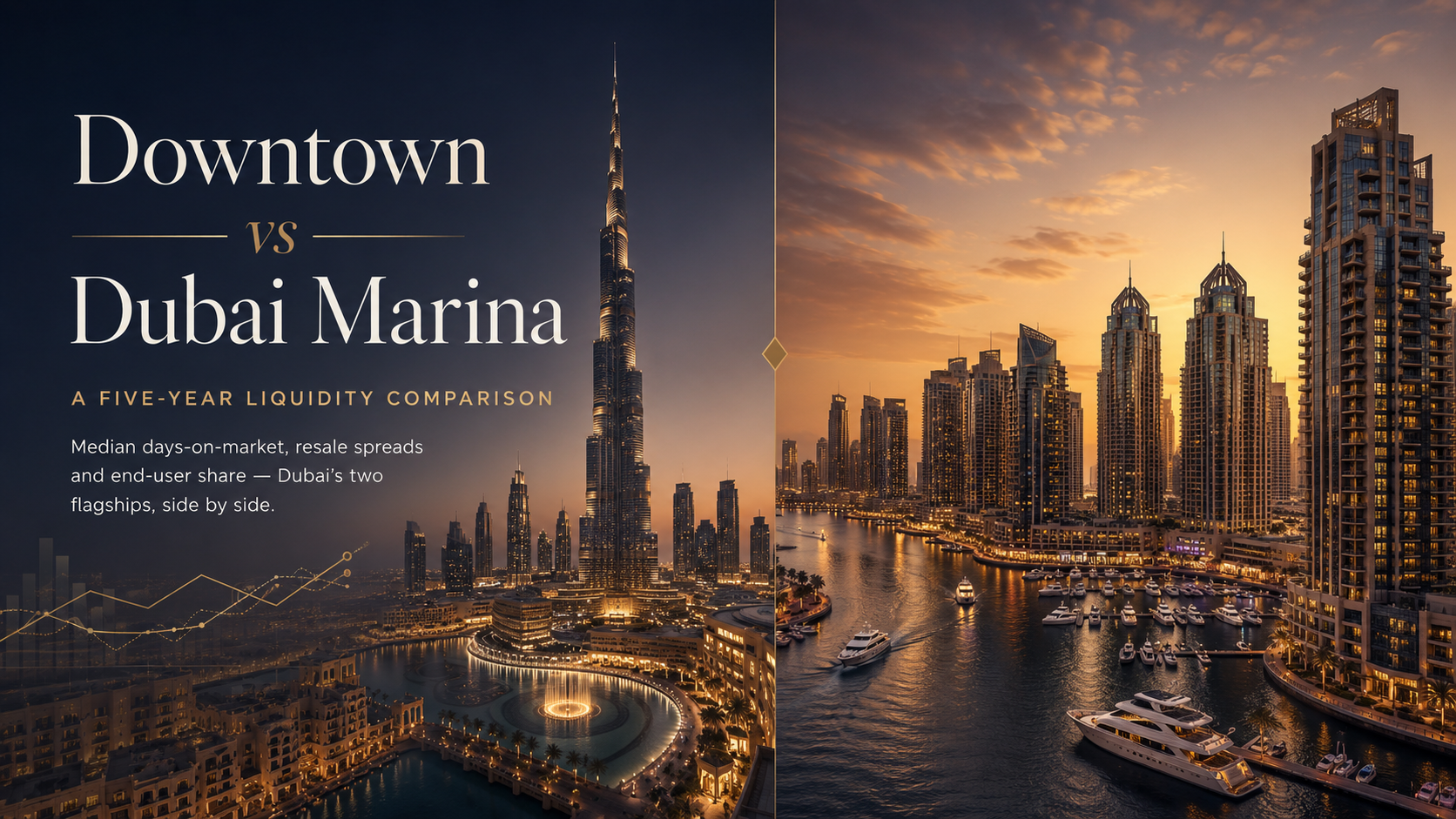
Downtown Dubai and Dubai Marina are often grouped together as Dubai's flagship residential districts. Both are globally recognised, highly liquid by Dubai standards, and popular with international buyers. Both offer established infrastructure, strong rental demand and a deep history of completed transactions.
But from an investment perspective, they are not the same market.
A property investor should not only ask:
"Which area is more expensive?"
The better question is:
"Which area is easier to exit, at what price, and to which buyer profile?"
That is where liquidity matters.
At EGRE, we assess liquidity through several indicators: median days-on-market, resale spreads, buyer depth, end-user share, rental demand, building-level comparables and the gap between asking prices and achieved transactions.
Over a five-year view, Downtown and Dubai Marina both remain important markets — but they behave differently through cycles.
Why liquidity matters more than headline price
In real estate, liquidity is often misunderstood.
A property may look valuable on paper, but if the buyer pool is thin, the asset may take longer to sell or require a deeper discount to clear.
A liquid market has several advantages:
- More comparable transactions
- Greater buyer confidence
- Cleaner valuation evidence
- Faster resale potential
- Lower exit uncertainty
- Better lender comfort
- More resilient pricing during softer periods
For investors, this is critical. The entry price matters, but the exit environment matters just as much.
A good acquisition is not only about buying well. It is about knowing how the asset can be sold later.
Downtown Dubai: global recognition, but price sensitivity
Downtown Dubai has one of the strongest brands in the region. The Burj Khalifa, Dubai Mall, DIFC proximity and global recognition make it a prestige location for both end-users and investors.
Its appeal is clear: centrality, lifestyle, infrastructure and global identity.
However, Downtown is also highly price-sensitive. Many buildings trade at premium levels, and buyers often compare Downtown not only with other Dubai districts but with international gateway-city real estate.
This means that liquidity is strongest when the asset has a clear reason to justify its price: view, tower quality, layout, floor level, building reputation, service charge profile or scarcity.
Generic stock in Downtown can still be liquid, but it may not command the same depth of demand as trophy-facing or best-in-class units.
In Downtown, the difference between prime and average is significant.
Dubai Marina: depth, lifestyle and constant rental demand
Dubai Marina is one of Dubai's most mature residential markets. It benefits from waterfront living, walkability, beach proximity, strong rental demand, large tenant depth and a long-established secondary market.
From a liquidity perspective, Marina has an important advantage: transaction depth.
There is usually a broad buyer and tenant pool, from investors and owner-occupiers to lifestyle buyers and relocating professionals. This creates a more active resale environment, particularly for correctly priced stock in well-regarded towers.
Dubai Marina is also easier for many international buyers to understand. It has a clear lifestyle proposition: waterfront, towers, restaurants, beach access, metro/tram connectivity and established community infrastructure.
That clarity supports liquidity.
However, Marina is not immune to risk. Building selection is critical. Service charges, tower age, maintenance quality, parking, view, floor height and layout can materially affect both rentability and resale performance.
Days-on-market: the first liquidity signal
Median days-on-market is one of the most useful early indicators of liquidity.
If a unit sits on the market for a long period despite repeated exposure, one of three things is usually wrong:
- The asking price is too high.
- The unit has a weakness the market recognises.
- The buyer pool for that asset is thinner than the seller believes.
In both Downtown and Marina, the best assets can move quickly when priced correctly. But overpriced units can remain listed for months, particularly when sellers price above recent transaction evidence.
Days-on-market should therefore be reviewed at building and layout level, not only district level.
A one-bedroom in a highly liquid Marina tower may behave very differently from a large unit in a less active building. Likewise, a Burj-facing Downtown unit may have a deeper buyer pool than a generic unit with no view premium.
The district matters. The building matters more.
Resale spreads: the gap between expectation and reality
Another key measure is the resale spread: the difference between asking prices, recent achieved prices and what a buyer is actually willing to pay.
In strong markets, sellers often anchor to the highest visible listing. In more selective markets, buyers anchor to actual transactions.
This creates a gap.
Downtown sellers may expect a premium because of location and prestige. Marina sellers may expect resilience because of liquidity and lifestyle demand. But in both markets, the true clearing price is determined by completed transactions, not advertised optimism.
A wide spread between asking and achieved prices is often the first sign that the market is becoming less liquid.
For investors, this can create opportunity. When sellers remain anchored to peak expectations, patient buyers can identify units where the actual clearing price is lower than the public narrative suggests.
End-user share: why buyer type matters
Liquidity quality depends not only on how many buyers exist, but on who those buyers are.
A market dominated by investors can move quickly in rising conditions, but may become more volatile when sentiment changes.
A market with a stronger end-user base can be more stable, because buyers are motivated by lifestyle, location and long-term occupation rather than short-term return alone.
Downtown and Marina both attract investors and end-users, but the balance differs by building, unit type and price point.
Downtown often attracts prestige buyers, investors, short-stay operators and internationally mobile clients.
Dubai Marina attracts a broad mix of investors, end-users, tenants, relocation clients and lifestyle buyers.
This diversity is one of Marina's strengths. It creates multiple exit routes: investor resale, end-user sale, rental hold or lifestyle repositioning.
Investment interpretation
For investors, Downtown and Marina should not be viewed simply as "prime areas". They should be understood as different liquidity strategies.
Downtown is more brand-led, prestige-led and price-sensitive. The strongest assets are those with scarcity, view, building quality and international appeal.
Dubai Marina is more lifestyle-led, rental-demand-led and transaction-depth-led. The strongest assets are those in well-managed towers with efficient layouts, good views, sensible service charges and proven rental demand.
Both can work. Both can disappoint if bought badly.
The difference is in the underwriting.
What EGRE looks for
When comparing Downtown and Marina opportunities, EGRE focuses on:
- Recent DLD transactions
- In-building resale evidence
- Layout-matched comparables
- Days-on-market
- Competing live stock
- Service charges
- Achievable rent
- Net yield after costs
- End-user versus investor demand
- Resale exit depth
- Price gap versus comparable completed sales
We are not looking for the most attractive brochure. We are looking for the cleanest investment logic.
In both Downtown and Marina, the best opportunities are rarely found by looking at headline district averages. They are found by analysing specific buildings, specific layouts and specific seller motivation.
EGRE view
Downtown and Dubai Marina remain two of Dubai's most important residential markets. But they should not be treated as interchangeable.
Downtown offers prestige, centrality and global recognition. Marina offers lifestyle depth, rental demand and broad resale liquidity.
For a capital preservation buyer, the question may be which asset has the strongest long-term scarcity.
For a yield-led investor, the question may be which building delivers the best net return after service charges and voids.
For a future exit, the question is simple: where is the buyer pool deepest, and what evidence supports the resale price?
The answer is rarely found in a headline average.
It is found in the transaction evidence.
At EGRE, we compare Downtown and Marina through liquidity, not hype — because in a changing market, the most important number is not always the price you pay. It is the price at which you can exit.