%20scale(0.100000,-0.100000)'%20fill='%23000000'%20stroke='none'%3e%3cpath%20d='M1100%2012055%20l0%20-2695%202310%200%202310%200%200%20385%200%20385%20-1925%200%20-1925%200%200%20770%200%20770%201925%200%201925%200%200%20385%200%20385%20-1925%200%20-1925%200%200%20770%200%20770%201925%200%201925%200%200%20385%200%20385%20-2310%200%20-2310%200%200%20-2695z%20M6550%2012060%20l0%20-2690%202690%200%202690%200%200%201535%200%201535%20-1535%200%20-1535%200%200%20-385%200%20-385%201150%200%201150%200%200%20-770%200%20-770%20-1920%200%20-1920%200%200%201925%200%201925%202305%200%202305%200%200%20385%200%20385%20-2690%200%20-2690%200%200%20-2690z%20M1100%205805%20l0%20-2695%20385%200%20385%200%200%20770%200%20770%201073%200%201072%20-1%2075%20-82%20c41%20-45%20360%20-392%20708%20-770%20l633%20-687%20524%200%20c289%200%20525%202%20525%205%200%203%20-109%20124%20-242%20268%20-608%20657%20-1153%201251%20-1156%201258%20-2%205%20314%209%20702%209%20l706%200%200%201925%200%201925%20-2695%200%20-2695%200%200%20-2695z%20m4620%20770%20l0%20-1155%20-1925%200%20-1925%200%200%201155%200%201155%201925%200%201925%200%200%20-1155z%20M7320%205795%20l0%20-2695%202305%200%202305%200%200%20385%200%20385%20-1920%200%20-1920%200%200%20770%200%20770%201920%200%201920%200%200%20385%200%20385%20-1920%200%20-1920%200%200%20770%200%20770%201920%200%201920%200%200%20385%200%20385%20-2305%200%20-2305%200%200%20-2695z'/%3e%3c/g%3e%3c/svg%3e)
Cross-border · 10 min read
A Chinese Investor's Guide to Buying Property in Dubai
Account structures, FX pathways, ownership options and cross-border considerations for Chinese private clients acquiring Dubai real estate.
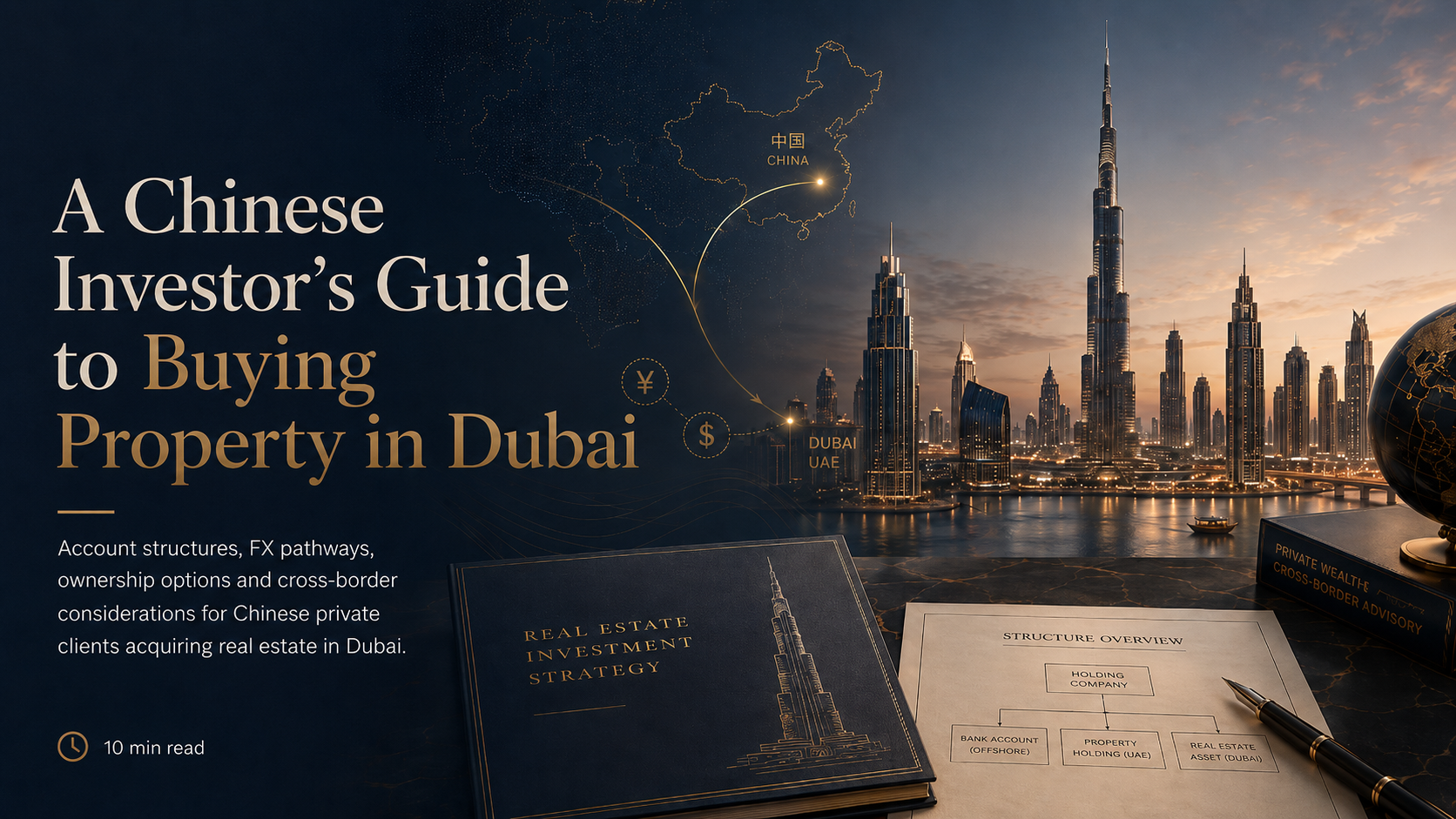
Dubai has become one of the most active international property markets for Chinese private clients. The appeal is clear: no annual property tax, no personal income tax on rental income, a transparent land registry, strong rental demand, world-class infrastructure and a growing role as a global wealth hub.
But for Chinese investors, the key question is rarely just:
"Which property should I buy?"
The more important question is:
"How should the purchase be structured, funded, owned and managed?"
A good Dubai acquisition begins before the property search. It starts with the investor's capital position, banking arrangements, FX pathway, ownership objectives and long-term exit plan.
At EGRE, we advise Chinese clients across the full acquisition journey — from property selection and due diligence to account setup, ownership structure, rental management and eventual resale strategy.
1. Dubai is simple to buy into — but should still be structured properly
Dubai is relatively straightforward for foreign property buyers. In designated freehold areas, non-UAE nationals can acquire property in their own name, through certain corporate structures, or through suitable ownership vehicles depending on the asset, lender requirements and long-term planning objectives.
For many private investors, personal ownership may be sufficient.
For others — especially family offices, business owners, multi-property investors or clients acquiring for succession planning — the structure deserves more thought.
The correct approach depends on:
- Whether the property is for investment, lifestyle use or future relocation
- Whether rental income will be generated
- Whether finance is required
- Whether the asset may later be transferred, refinanced or sold
- Whether the buyer is acquiring alone, with a spouse, family member or company
- Whether the asset forms part of a wider global portfolio
The mistake is to treat structure as an afterthought. Once the wrong buyer name or vehicle is placed on a Sales Purchase Agreement, changing it later can create cost, delay and unnecessary friction.
2. Capital pathway matters as much as property selection
For Chinese investors, moving capital across borders requires planning.
The Dubai side of the transaction is usually clear: the seller, developer, trustee office or escrow account requires payment in AED, usually according to an agreed payment schedule.
The more complex part is often the funding pathway before the money reaches Dubai.
Investors should consider:
- Where the funds are currently held
- Whether capital is inside mainland China, Hong Kong, Singapore, the UAE, the UK or another jurisdiction
- Whether the investor already has international banking access
- Whether funds are being remitted personally or through an entity
- Whether proof of source of funds can be clearly documented
- Whether future rental income will remain in the UAE or be moved elsewhere
The strongest investors prepare this early. They do not wait until a deal is agreed before thinking about banking.
3. Bank accounts and payment mechanics
A Dubai property purchase can often be completed without the buyer having a UAE bank account at the outset, especially for cash acquisitions or off-plan purchases where payments are made to a developer escrow account.
However, a UAE bank account can become important for:
- Receiving rental income
- Paying service charges
- Managing property expenses
- Applying for a mortgage
- Building UAE banking history
- Supporting future residency or business activity
- Holding AED rather than repeatedly converting currency
For overseas Chinese clients, account opening may require documentation including passport, visa or entry stamp, address details, bank statements, source of funds evidence and sometimes proof of business or employment activity.
Requirements vary by bank and client profile, so this should be addressed early in the process.
A property acquisition is much smoother when the account, FX and compliance pathway is planned before a reservation agreement is signed.
4. FX: the real cost is not only the exchange rate
Many investors focus only on the quoted exchange rate from RMB, HKD, USD or another currency into AED. But the true cost of FX includes more than the headline rate.
Investors should also consider:
- Transfer fees
- Intermediary bank charges
- Timing risk between reservation and completion
- Currency volatility during staged off-plan payments
- Whether AED, USD or another currency is being used as the base
- Whether payments are one-off or spread across several years
This is especially important for off-plan purchases.
A buyer may agree a purchase price today, but if payments are made over 24, 36 or 48 months, the actual cost in the buyer's home currency can move materially depending on FX conditions.
For larger acquisitions, FX should be treated as part of the investment analysis, not an administrative detail.
5. Off-plan purchases need a different kind of underwriting
Off-plan property is popular with international buyers because it offers staged payments, new stock, lower immediate capital deployment and potential capital growth before handover.
But off-plan also requires discipline.
The key question is not simply whether the brochure looks attractive or whether the launch price appears competitive.
The investor should ask:
- Is the developer credible?
- Is the payment plan genuinely attractive or simply priced into the purchase price?
- What is the expected handover supply in the same area?
- What are comparable completed units trading for today?
- What rent is realistically achievable after handover?
- What service charges are likely?
- What happens if the resale market is soft at completion?
- Is there enough end-user depth or is the exit mainly dependent on other investors?
The most common mistake is comparing off-plan pricing only against other off-plan launches. The better approach is to compare against completed stock, actual resale evidence and likely rental performance at handover.
A project can be visually impressive and still be a poor investment if the entry price, supply pipeline or exit liquidity does not work.
6. Secondary property gives more evidence — but still needs analysis
Secondary property has one clear advantage: there is usually more transaction evidence.
An investor can review DLD records, recent in-building resales, current competing listings, achieved rents and service charges before committing.
This gives a more evidence-based view of value.
However, secondary property also brings its own risks:
- Overpriced asking levels
- Poorly maintained buildings
- Unrealistic rental expectations
- Weak layouts
- High service charges
- Limited resale demand
- Tenant or vacancy complications
- Hidden maintenance costs
For Chinese investors who are not based in Dubai, local execution becomes critical. The buyer needs more than a listing link. They need a proper assessment of the building, unit, rentability, service charge profile and resale depth.
In Dubai, two units in the same district can perform very differently. Even two units in the same tower may have different liquidity depending on view, floor, layout, condition and price.
7. Ownership options: personal, company or family structure
There is no single correct ownership structure for every buyer.
Some investors buy personally because it is simple, direct and cost-effective.
Others prefer corporate or family-linked structures for privacy, succession planning, asset separation or portfolio management.
The decision should consider:
- Purchase price
- Number of properties being acquired
- Whether income will be generated
- Whether debt finance is required
- Whether the property may be transferred later
- The buyer's tax residency
- Estate planning considerations
- Banking and compliance requirements
- Exit strategy
The structure should be reviewed with qualified legal, tax and banking advisers before completion. EGRE's role is to coordinate the property advisory process and ensure the acquisition strategy is aligned with the client's wider objectives.
8. Rental income and management
Many Chinese investors acquire Dubai property for income. But rental performance depends heavily on the asset, building, furnishing, tenant profile and management quality.
Gross rent is not the same as net return.
A proper rental model should account for:
- Service charges
- Property management
- Letting fees
- Maintenance
- Furnishing
- Vacancy periods
- Renewal assumptions
- Potential rent regulation considerations
- Resale liquidity
For overseas owners, professional management is usually essential. The investor needs rent collection, tenant communication, maintenance coordination, inspection reporting and compliance handled locally.
This is particularly important when the client is based in mainland China or elsewhere in Asia and cannot personally manage day-to-day issues in Dubai.
A strong property manager protects both income and asset value.
9. Residency and long-term planning
Dubai property can also form part of a wider relocation, residency or family planning strategy.
For some clients, the investment objective is income. For others, it is capital preservation, future relocation, children's education, lifestyle access, business expansion or regional diversification.
This matters because the right property for a pure yield investor may not be the right property for a family considering future use.
A high-yield apartment in a busy investor district may work financially, but a family planning to spend time in Dubai may prefer a different location, building quality, school access or lifestyle environment.
The investment purpose should be defined before the search begins.
10. The EGRE view
Dubai remains one of the most compelling global property markets for Chinese private capital, but the best results come from structure and discipline.
The investor should not begin with a brochure.
They should begin with a plan:
- How will the capital reach Dubai?
- What currency risk exists?
- What ownership structure is suitable?
- Is the asset for income, growth, lifestyle or relocation?
- What evidence supports the price?
- What is the realistic net return?
- How liquid is the exit?
- Who will manage the asset after completion?
At EGRE, we combine Dubai market execution with Chinese client advisory and cross-border transaction experience. Our role is to help clients move from interest to acquisition with clarity: the right asset, the right structure, the right operating plan and the right long-term strategy.
For Chinese investors, buying in Dubai is not difficult.
Buying well requires discipline.